
ChronoFilter
Phase Smearing. Harmonic Folding. Physical Resonance. One Masterpiece.
Currently exclusive to Windows systems (additional OS support in development).
What is it?
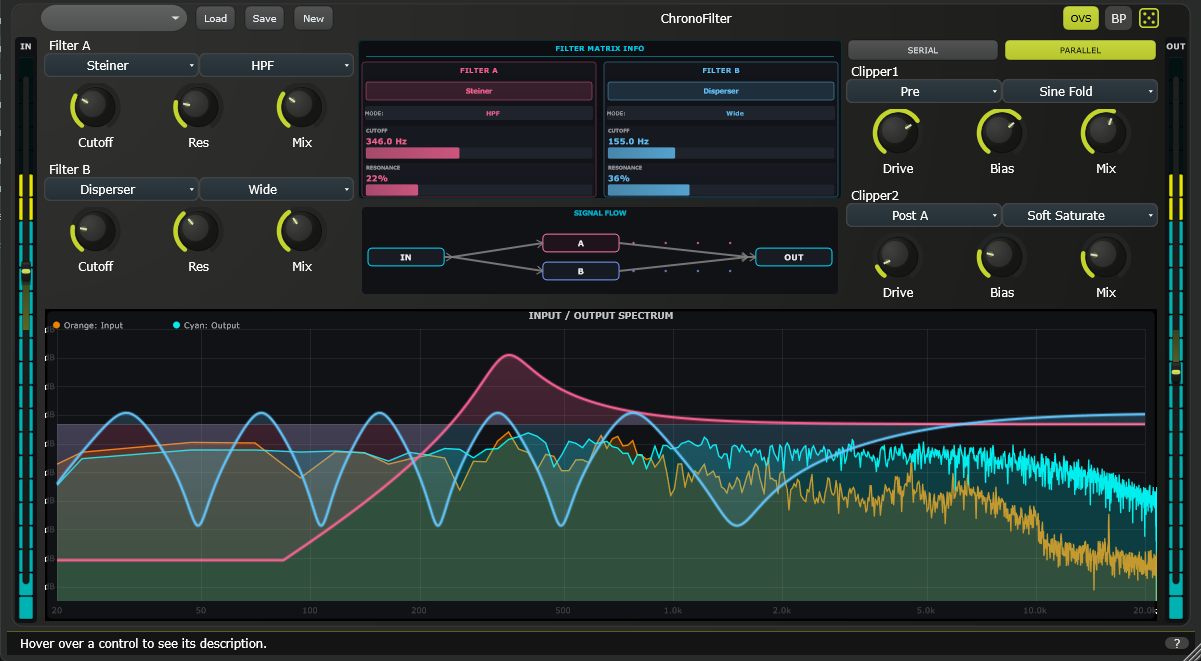
ChronoFilter is a dual-engine spectral shaping station that goes far beyond simple EQ. It is a collection of 13 distinct analog and esoteric filter topologies modeled with "Zero-Delay Feedback" (TPT) technology.
Unlike standard digital filters that cramp at high frequencies, ChronoFilter mimics the electrical behavior of vintage hardware. It features two independent filter slots (A and B) that can be routed in Series, Parallel, or anywhere in between.
From the squelch of a silver box to the vocal cry of a formant resonator, this module turns frequency removal into a creative instrument.
Key Features
-
1
The "Tessera" Filter Arsenal
The core of the unit is the filter library, offering 13 unique algorithms:
- Analog Models: Classic Ladder, OTA, Squelchy Diode (acid bass texture), and Gritty Sallen-Key.
- Creative Shapers: Comb Resonator (flanging/metallic tones), Vowel Formant (morphing A-E-I-O-U talkbox effects), and Phaser (up to 12-stage phase shifting).
- Physical & Spectral: Modal Resonator (creates physical "plucks" and bells) and Spectral Shaper (complex tilt/notch sculpting).
-
2
Dual-Engine Morphing Architecture
You aren't limited to one sound. The module runs two complete filter engines (Filter A and Filter B) simultaneously. A continuous Routing knob allows you to morph the signal path from Parallel (splitting the audio into two layers) to Series (running Filter A into Filter B). This lets you, for example, distort a signal with a Diode Ladder in parallel with a clean High-Pass, preserving the low-end punch while mangling the top.
-
3
"Smart" Oversampling
Analog filters generate harmonics that can cause digital "aliasing" (harsh noise). ChronoFilter features an intelligent Automatic Oversampling engine. The code detects when you select a non-linear profile (like Ladder, OTA, or Diode) or push the Drive hard, and instantly engages 4x Oversampling. This ensures that even at extreme resonance settings, your top end remains silky smooth and artifact-free.
-
4
Integrated Character Saturation
Filters sound best when pushed. Each filter slot is equipped with a dedicated Character Processor, allowing you to drive the input before or after the filter cutoff. This mimics the gain staging of vintage synthesizers, where the filter creates its own harmonic distortion as it resonates.
-
5
Modal & Formant Synthesis
Turn noise into music. The Modal Resonator profile tunes the filter into a bank of resonant bandpasses (Odd, All, Inharmonic), allowing you to "strum" the filter with noise bursts to create bells, drums, and chords. The Formant profile uses dual-peak filtering to mimic the human vocal tract, allowing you to sequence vowel sounds via the "Multi" parameter.
Audio Demos
Specifications
FAQ
Q:What makes the "Modern SVF"
different from the "Classic Ladder"?
+
The Modern SVF (State Variable Filter) is designed for surgical cleanliness and transparency. It allows you to boost bass or cut highs without adding color. The Classic Ladder, however, is physically modeled on vintage hardware. As you increase the Resonance on the Ladder, the bass naturally drops (a famous quirk of the original hardware), and the filter begins to saturate and "growl." Use Modern for mixing, and Ladder for sound design.
Q:What is the "Disperser" profile used
for?
+
The Phase Disperser profile is an All-Pass Filter chain (similar to a "laser zap" effect). It doesn't remove frequencies; instead, it smears them in time. It is incredible for processing drums—it can make a sharp, digital kick drum sound "gummy," punchy, and analog by rotating the phase of the transient frequencies.
Q:Why does the CPU usage change when I
switch filters?
+
This is the Smart Oversampling at work. If you are using a lightweight filter like "Tilt Shelf," the plugin runs at your project's sample rate to save CPU. If you switch to a heavy, non-linear model like "OTA" or "Squelchy Diode," the code automatically spins up the 4x Oversampling engine to calculate the complex math required for analog realism. We prioritize audio quality over CPU when it counts.