

ChronoComp
Phase Smearing. Harmonic Folding. Physical Resonance. One Masterpiece.
Currently exclusive to Windows systems (additional OS support in development).
What is it?
The ChronoComp is a chameleon-like dynamics processor that houses four of the most legendary analog circuit behaviors in a single module. It is not just a digital compressor; it is a Topology Morphing Engine.
Instead of approximating different sounds with generic algorithms, this module completely reconfigures its internal DSP architecture when you switch modes. Whether you need the lightning-fast grab of a solid-state FET, the slow, non-linear hug of an Optical cell, the transparent control of a VCA, or the harmonic richness of a Vari-Mu tube, the Advanced Compressor transforms into the exact tool you need, complete with context-sensitive controls that match the original hardware.
Key Features
-
1
Four Distinct Circuit Topologies
The engine features four meticulously modeled compression behaviors:
- VCA (Clean): A modern, transparent, and punchy detector perfect for bus compression and "glue."
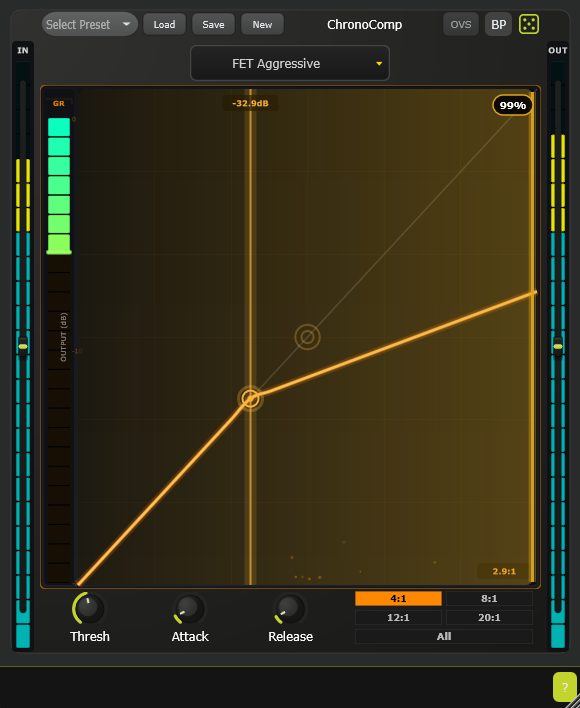
- FET (Aggressive): Modeled on the classic "1176" style. It features fixed ratios (4:1, 8:1, 12:1, 20:1, and "All") and an ultra-fast attack time.
- Opto (Smooth): Simulates the physics of a light-dependent resistor (LA-2A style). It creates a smooth, laggy release character that is impossible to replicate with standard envelopes.
- VariMu (Lush): Emulates the non-linear gain reduction of vintage tube limiters, adding "thick" harmonic saturation as it compresses.
-
2
Context-Sensitive "Morphing" UI
To ensure you use each model correctly, the interface physically changes based on your selection.
- In FET Mode: The Threshold knob disappears (as FETs have fixed thresholds), replaced by an Input drive knob. The Knee knob transforms into a Saturation control to drive the output transformer.
- In Opto Mode: The Threshold becomes Reduce, and an exclusive Emphasis knob appears, allowing you to tune the sidechain's frequency sensitivity for vocals.
-
3
"Flux-Lookahead" Technology
Analog compressors are reactive; they can only compress after a peak hits. ChronoComp includes a digital Lookahead Engine (up to 5ms). This utilizes a delay line to analyze the incoming audio stream before it hits the gain reduction cell, allowing the compressor to react instantly to transients with zero overshoot, creating a "wall" of control that analog gear cannot achieve.
-
4
High-Fidelity "Crème de la crème" Tube Modeling
The Vari-Mu mode utilizes a specialized Creme DSP class. This isn't just a volume fader; it simulates the transfer curve of a vacuum tube. As you push the compression harder, the signal naturally soft-clips and thickens, adding the coveted "expensive" sound to sterile digital sources.
Audio Demos
Specifications
FAQ
Q:Why does the "Ratio" knob disappear
in FET mode?
+
In the original hardware that the FET mode models, the ratio was selected via push-buttons, not a knob. To recreate this authentic behavior and the specific knee characteristics associated with it, the Advanced Compressor replaces the continuous Ratio knob with a set of Ratio Buttons (4:1, 8:1, 12:1, 20:1, All) when you switch to FET mode.
Q:What is the "Emphasis" control in
Opto mode?
+
The Emphasis knob controls a sidechain filter specific to the Opto topology. In vintage optical units, the photocell was often more sensitive to bass frequencies. Turning the Emphasis knob adjusts how much high-frequency content triggers the compressor relative to the low end. It is particularly useful for keeping vocals present without crushing them every time a kick drum hits.
Q:Does the "Saturation" knob in FET
mode affect the volume?
+
The Saturation control (which replaces the Knee knob in FET mode) drives the internal non-linear stage of the modeled output amplifier. While it adds harmonic grit and density, the code includes internal gain compensation to keep the perceived level relatively stable, allowing you to color the sound without ruining your gain staging.