
Momentum
Phase Smearing. Harmonic Folding. Physical Resonance. One Masterpiece.
Currently exclusive to Windows systems (additional OS support in development).
What is it?
Momentum is a real-time audio mutator that captures your signal, freezes it in a temporal buffer, and replays it in reverse. But unlike a standard "reverse delay" that just repeats what you played, Momentum is designed as a Rhythmic Texturizer.
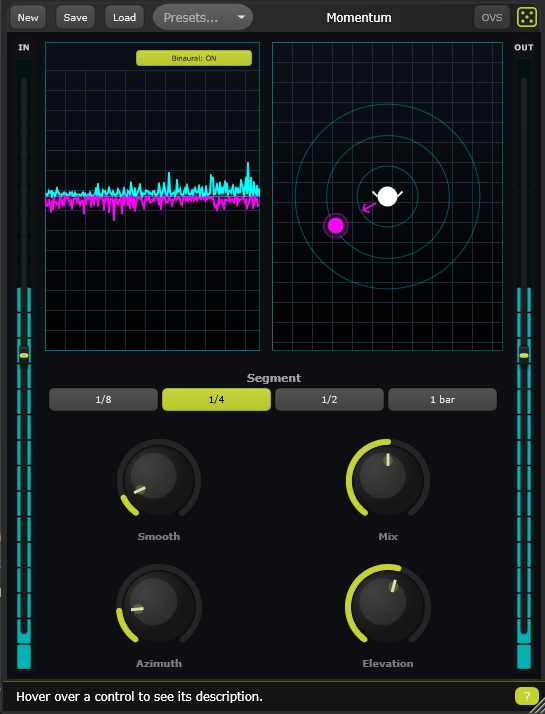
It slices incoming audio into musical subdivisions (from 1/8th notes to full bars), flips them instantly, and places the result into a Virtual 3D Space. Under the hood, it utilizes a "Flux-Reverse Architecture" with double-buffering, ensuring that as one segment plays back, the next is already being captured.
The result is a continuous, glitch-free stream of reversed audio that can be seamlessly blended from a rhythmic chop to an atmospheric wash.
Key Features
-
1
The "Flux-Reverse" Engine
Standard reverse effects often click or pop at loop points. Momentum uses a dual-buffer topology with a variable Smooth Crossfader, ensuring seamless transitions between reversed segments without audible artifacts.
-
2
True 3D Binaural Positioning
Momentum does not simply pan sound left and right. It features a dedicated Binaural Panner class that simulates how the human ear perceives sound in three-dimensional space:
- Azimuth (Left/Right): Uses Interaural Time Differences (ITD) and head-shadowing filters to place sound precisely around your head.
- Elevation (Up/Down): Implements pinna cues via a dynamic spectral notch (N1) that sweeps from 6 kHz to 10.5 kHz, tricking the brain into perceiving vertical movement.
-
3
Distance & Atmosphere Simulation
The Distance control goes beyond simple volume attenuation. As the sound is pushed further away, the engine engages multiple psychoacoustic processes:
- Air Absorption: A dynamic low-pass filter that rolls off high frequencies from 16 kHz down to 4 kHz to simulate sound traveling through air.
- Width Collapse: The stereo image narrows automatically as distance increases, mimicking the acoustic behavior of a distant point source.
-
4
Integrated Early Reflections
To ground the reversed signal in reality, the spatial engine includes a six-tap Early Reflection generator. These micro-delays are tuned dynamically based on Azimuth and Distance settings, creating a phantom room around the reversed grains so they feel spatially anchored rather than dry or pasted on.
-
5
Cyber-Spatial Visualization
The user interface features a Binaural Radar and a real-time waveform display. The Radar visualizes the current Azimuth and Distance of the reversed signal relative to the listener, providing immediate visual feedback on where the texture sits within the stereo field.
Audio Demos
Specifications
FAQ
Q:How is this different from a reverse
delay plugin?
+
A reverse delay typically captures a loop, waits for it to finish, and then plays it back, introducing latency equal to the loop length. Momentum operates on a Grid-Locked Segmentation basis. While there is inherent latency in reversing audio, Momentum handles buffering in parallel with the dry signal and produces a continuous stream of reversed grains. The result feels closer to a granular synthesis effect than a traditional delay.
Q:Why does the stereo width get
narrower when I increase the Distance?
+
This behavior is based on real-world psychoacoustics. Sounds that are close to the listener have wide stereo separation due to large differences between the left and right ears. As a sound source moves farther away, the angle between it and the ears decreases, and the signal arrives more equally at both ears. Momentum models this by gradually collapsing the stereo image toward mono as the Distance parameter approaches 100%.