
Helical Delay
Phase Smearing. Harmonic Folding. Physical Resonance. One Masterpiece.
Currently exclusive to Windows systems (additional OS support in development).
What is it?
Helical Delay is not your standard echo unit; it is a spiraling, pitch-shifting texture generator inspired by the legendary "Dual-Head" rack processors of the 1980s.
While standard delays simply repeat audio, Helical Delay treats time as a malleable surface. It utilizes a Dual-Read-Head Architecture to decouple pitch from playback speed, allowing you to create shimmering crystals, descending doomsday drones, and detuned stereo widener effects that remain perfectly smooth.
Combined with a multi-tap topology (up to 6 taps) and a "Grit" saturation engine, it excels at turning simple dry signals into complex, rotating atmospheres that seem to spin around the listener's head.
Key Features
-
1
Dual-Head Pitch Shifting
Most delays change pitch by changing speed. Helical Delay uses a sophisticated Windowed Dual-Head algorithm. By crossfading between two playheads 180° out of phase, it achieves clean, musical pitch shifting (+/- 24 semitones) without altering the delay rhythm.
- 3 Window Modes: Select between Silky, Warm, or Precise window profiles to tailor the grain of the pitch shift.
-
2
Multi-Tap Spiral Topology
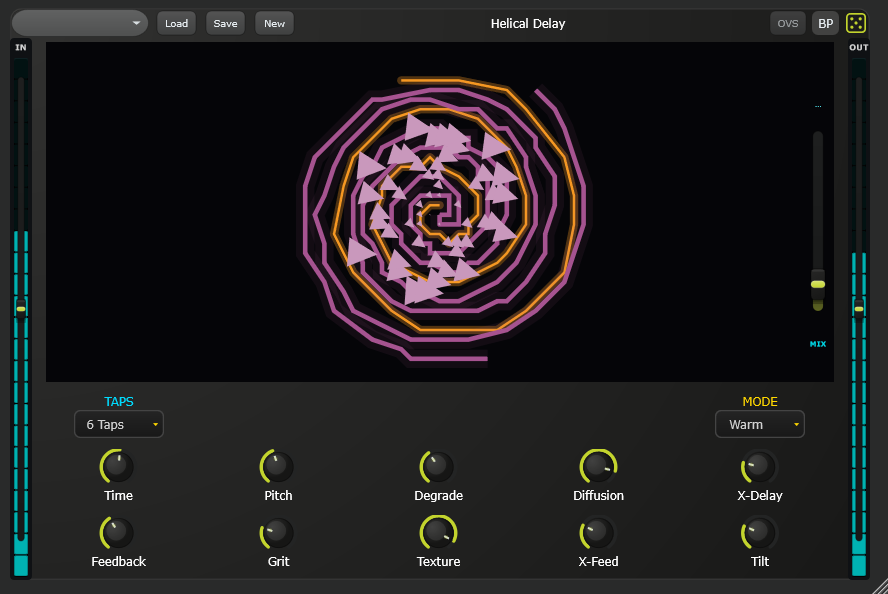
You aren't limited to a single echo. You can select 2, 4, or 6 Delay Taps. The engine automatically calculates a unique pan position and time offset for each tap, creating a "helical" structure where echoes appear to rotate and spiral outward in the stereo field. Each tap has its own independent LFO modulation with slightly offset rates, ensuring the stereo image feels organic and alive, never static.
-
3
"Grit" & "Degrade" Topology
This module doesn't just fade out; it falls apart.
- Grit: Applies a hyperbolic saturation curve inside the feedback loop, adding harmonics and warmth as the echoes repeat.
- Degrade: A dynamic anti-aliasing filter that darkens the sound based on the sample rate, simulating the bandwidth loss of early digital delay units.
-
4
Diffusion & Smear
To bridge the gap between "Delay" and "Reverb," the feedback path includes a cascaded Dual-Stage network. Increasing the Diffusion knob smears the transient attacks of the echoes, turning distinct taps into a wash of ambient texture.
-
5
Cross-Feedback with "X-Delay"
For maximum stereo width, the module features a dedicated Cross-Feed Delay line (approx. 3ms to 12ms).
Audio Demos
Specifications
FAQ
Q:What is the difference between
"Time" and "Pitch"?
+
In a standard tape delay, changing Time changes Pitch. In Helical Delay, they are independent.
- Time controls the buffer length (the rhythm of the echoes).
- Pitch controls the playback rate of the Dual Heads relative to the write head. Example: You can set a long 1000ms delay time, but set Pitch to +12 semitones. The result is distinct echoes that arrive 1 second later, but sound an octave higher (shimmer effect).
Q:Why do the echoes sound "lo-fi" when
I turn up the Degrade knob?
+
The Degrade parameter engages a system that mimics the low-pass filtering found in vintage digital samplers. As you increase Degrade, you effectively simulate a lower sample rate without the harsh digital aliasing noise.
Q:What is "Texture" doing to the
sound?
+
The Texture parameter is a macro control that affects multiple internal variables.
- It increases the modulation depth of the LFOs affecting the tap times (creating a chorus/wow-and-flutter effect).
- It modifies the Window Overlap of the pitch-shifting heads. Higher texture values create a more granular, overlapping sound, while lower values sound tighter and more rhythmic.