
ChronoMod
Phase Smearing. Harmonic Folding. Physical Resonance. One Masterpiece.
Currently exclusive to Windows systems (additional OS support in development).
What is it?
ChronoMod is a multi-dimensional modulation engine that transcends the boundaries of standard Chorus and Flanging. It is a Flux-Voice Topology processor designed to create movement that feels organic, unstable, and alive.
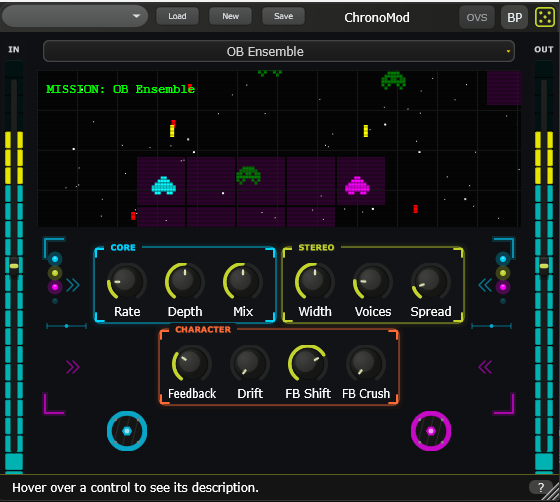
While traditional modulators simply wobble a delay line with an LFO, ChronoMod uses a "Unified Modulation Architecture" that can morph between classic analog behaviors (like the OB Ensemble and Dimension spatializers) and modern, impossible effects like Thru-Zero Flanging.
With the ability to insert frequency shifting and bit-crushing directly into the feedback loop, it transforms simple detuning into a spiraling, texture-generating machine.
Key Features
-
1
The "Flux-Voice" Ensemble Engine
For massive stereo width, ChronoMod features an OB Ensemble mode capable of stacking up to 16 independent voices. Unlike static plugins, this engine utilizes a Chaotic LFO (Drift) system. This introduces randomized micro-timing errors to the rate and pan of each voice, simulating the unstable clock circuits of vintage 80s polysynths for a lush, "swimming" texture that never repeats exactly the same way twice.
-
2
"Dirty" Feedback Loop
Standard modulation plugins have clean feedback. ChronoMod allows you to corrupt the recirculation path with two dedicated processors:
- Feedback Shift: Inserts a Bode-style Frequency Shifter into the loop. This creates "Barber Pole" effects where the modulation tail appears to rise or fall infinitely into the ether.
- Feedback Crush: Inserts a Bit-Crusher into the loop. As the signal recycles, it degrades in resolution, turning smooth flanges into robotic, dissolving artifacts.
-
3
True "Thru-Zero" Flanging
Most digital flangers can only delay the signal, meaning they can never reach the "null point" where the sound completely cancels out. ChronoMod uses a Time-Offset Buffer architecture. This allows the modulated signal to pass through the dry signal in time, creating the authentic "jet plane" suck-out effect found on vintage tape machines, impossible with standard delay lines.
-
4
Dimension Spatializer
For width without the wobble, the Dimension mode engages a cross-mixed, phase-inverted topology. It decouples the pitch modulation from the stereo image, creating a static, motionless 3D broadening effect that works perfectly on vocals and pads where you want size without "seasick" pitch drift.
-
5
Adaptive High-Definition Core
Modulation can be CPU intensive and prone to aliasing. ChronoMod features an Adaptive Oversampling engine. It monitors your "Rate," "Depth," and "Voice Count" settings in real-time. If you push the engine into extreme territory (e.g., fast rates or high voice counts), it automatically spins up a 2x Oversampling stage to ensure the high frequencies remain pristine and free of digital artifacts.
Audio Demos
Specifications
FAQ
Q:What does the "Drift" knob do?
+
The Drift knob injects chaos into the LFOs. In standard plugins, the LFO is a perfect, predictable sine wave. Increasing Drift engages a Chaotic Attractor algorithm that randomizes the speed and phase of the modulation voices. This mimics the "slop" and thermal instability of vintage analog circuits, making the chorus feel less robotic and more organic.
Q:How is "Dimension" mode different
from "Chorus"?
+
A standard Chorus creates width by varying the pitch (Doppler effect) between left and right channels, which can sound wobbly. The Dimension mode uses a specific trick: it inverts the phase of the modulation in the right channel and mixes the delayed signals across the stereo field. This cancels out the perception of pitch shifting while maximizing the perception of stereo width, making it ideal for widening sounds you want to keep "in tune."
Q:Why does the "FB Shift" knob make
the sound keep rising?
+
This is the Frequency Shifter inside the feedback loop. If you set it to +1Hz, the first repeat is shifted up 1Hz. The feedback loop takes that shifted signal and shifts it again to +2Hz, then +3Hz, and so on. This creates an auditory illusion called a "Shepard Tone," where the resonance of the flanger seems to ascend (or descend) forever without ever getting higher in actual pitch.