TEMPORARY SUSPENDED

FREE UNTIL APRIL 6: Get Triad for free before April 6th. Once claimed, the license is yours forever.

THE TRIAD

The Triangle of Destruction.

Triad is a multi-algorithm distortion and saturation processor. Its core interface revolves around an interactive XY triangle pad, allowing users to blend seamlessly between three distinct distortion characteristics.

CORE ENGINE

The Triangle

Top Corner: Analog

Function: Emulates physical hardware circuits, specifically tubes, tape, and transistors.
Result: Introduces harmonic saturation, non-linear drive, and soft-clipping. It provides standard hardware-style distortion.

TOPOLOGIES: Warm Triode, Dark Rich, NYC AMP, Master Tape, FET Console

Left Corner: Digital

Function: Utilizes digital degradation and hard mathematical clipping. This includes bit-crushing, sample rate reduction, and wave-folding techniques.
Result: Produces harsh, aggressive, and aliased artifacts. Ideal for extreme signal destruction and lo-fi processing.

TOPOLOGIES: Bitcrusher, Decimation, Hard Fold, Quantize Noise, Sample Drop
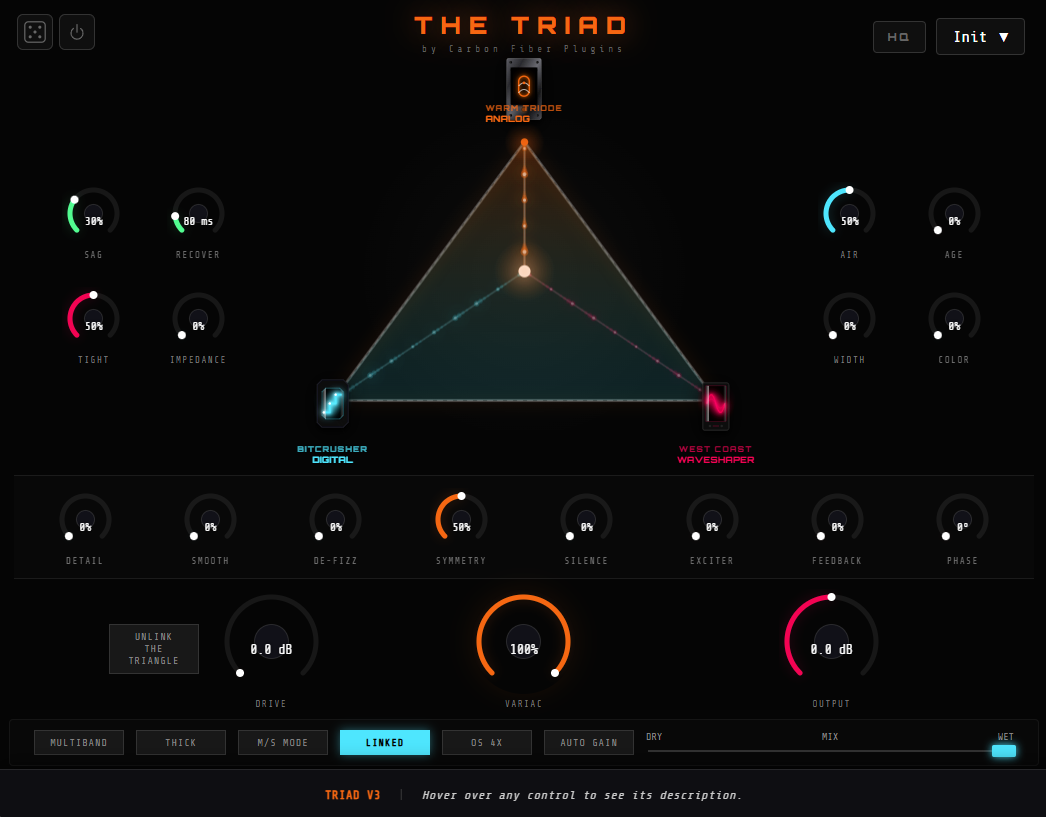
Triad Triangle Interface

Right Corner: Waveshapers

Function: Uses complex mathematical functions to map the input signal to specific output curves.
Result: Allows for precise, highly customizable distortion profiles that can range from subtle harmonic generation to extreme mangling depending on the input level.

TOPOLOGIES: West Coast, Lockhart Mult, Starved P-P, Sine Folder

DEMONSTRATION

Listen to the plugin!

SOUND DESIGN

Primary Tone Controls

These eight parameters surround the core processing and shape the immediate behavior and tone of the distortion.

SAG DYNAMICS

Simulates the voltage drop that occurs in hardware power supplies when the circuit is driven hard. It acts as a form of dynamic compression, reducing the transient peak and adding a reactive squash to the distortion.

Recover TIME

Determines the release time of the SAG effect. It controls how quickly the simulated voltage returns to normal after the signal level drops.

Tight FILTER

A pre-distortion high-pass filter. It removes low-end frequencies before the signal hits the distortion stage to prevent muddy, flubby, or undefined low-frequency distortion.

Impedance RESISTANCE

Alters the simulated input resistance of the circuit. This changes how the audio interacts with the distortion stage, shifting the frequency response and altering the character of the drive.

Air PRESENCE

A post-distortion high-frequency shelf boost. It restores high-end presence that is often lost during heavy clipping.

Age DEGRADATION

Simulates component degradation. It gently rolls off high frequencies and introduces subtle instability, mimicking the frequency response of older, worn hardware.

Width STEREO

Controls the stereo spread of the processed signal, allowing the distortion to be narrowed to mono or widened across the stereo field.

Color TONE

A tilt-EQ style control that shifts the overall tonal balance of the distortion, biasing the output towards a darker or brighter frequency response.

GRANULAR CONTROL

Advanced Shaping

Located under the Triangle, these parameters provide granular control over the artifact generation and the waveform manipulation.

Detail ARTICULATE

Enhances transient response and high-mid frequencies to articulate the sound and help the distorted signal cut through a dense mix.

Smooth DAMPING

Applies a dynamic low-pass filter or damping mechanism. It tames harsh transients and aggressive peaks introduced by heavy distortion.

De-fizz FILTER

A highly specific filter that targets and removes unwanted, ultra-high-frequency harshness (fizz) generated by the clipping stages.

Symmetry HARMONICS

Adjusts the balance between the positive and negative cycles of the waveform. Asymmetrical clipping introduces even-order harmonics, while symmetrical clipping emphasizes odd-order harmonics.

Silence GATE

A built-in noise gate. It mutes the output when the input signal drops below a defined threshold, eliminating the amplified background noise inherent in heavy distortion.

Exciter SYNTHESIS

Synthesizes and adds upper harmonics to the signal, increasing perceived brightness and presence without relying on standard EQ boosting.

Feedback RESONANCE

Routes a portion of the output signal back into the input stage. This creates internal resonance, self-oscillation, or dramatically thickened distortion depending on the amount applied.

Phase ALIGNMENT

Inverts or shifts the phase of the processed signal. This is primarily used for alignment when blending the distorted signal with a dry signal, preventing phase cancellation.

SYSTEM

Global & Utilities

Global & Performance Features

These features apply to the overall engine and operating mode of the plugin.

VARIAC

Simulates lowering the operating voltage of the internal power supply. This reduces the headroom of the plugin, causing distortion to occur earlier and with a grittier, more compressed character.

HQ Mode

Enables high-quality processing. This enhances the resolution of all utilities and significantly reduces digital aliasing (unwanted frequency reflection) when using intense distortion settings.

Bottom Utility Bar

These toggles and utilities manage routing, levels, and advanced processing modes.

  • Multiband Toggle: Splits the incoming audio signal into multiple frequency bands (Lows, Mids, Highs). This allows the user to apply entirely separate Triangle blends and parameter settings to each specific frequency band.
  • Thick: When enabled, Thick applies a musical, non-destructive 1st-order, 1-pole (6dB/octave) low-pass filter locked at 120Hz to the clean dry input, isolating sub-bass and kick transients before distortion occurs. This uncompressed sub-signal is boosted 1.5x and injected back into the saturated output, allowing heavy low-end to pierce through the compressed distortion wall. This process restores the massive punch and clarity typically lost to heavy tube distortion algorithms.
  • M/S (Mid/Side): Switches the plugin from standard Left/Right stereo processing to Mid/Side processing. This allows the user to distort the center of the mix (Mid) independently from the extreme stereo edges (Side).
  • Autogain: Automatically calculates and compensates for volume increases caused by the distortion stages, ensuring the output level matches the perceived input level.
  • Randomizer: Instantly randomizes all parameters within the plugin to generate unpredictable and unique distortion patches.

READY TO DESTROY?

Harness the power of the Triad.

GET TRIAD FOR FREE BEFORE APRIL 6TH

Once claimed, the license is yours forever.

Get Triad Now.
Windows and Mac VST3 Available

Report bugs and communicate with the devs on Discord.

Join Discord

SELECT TOPOLOGY

Triad UI Full Size